


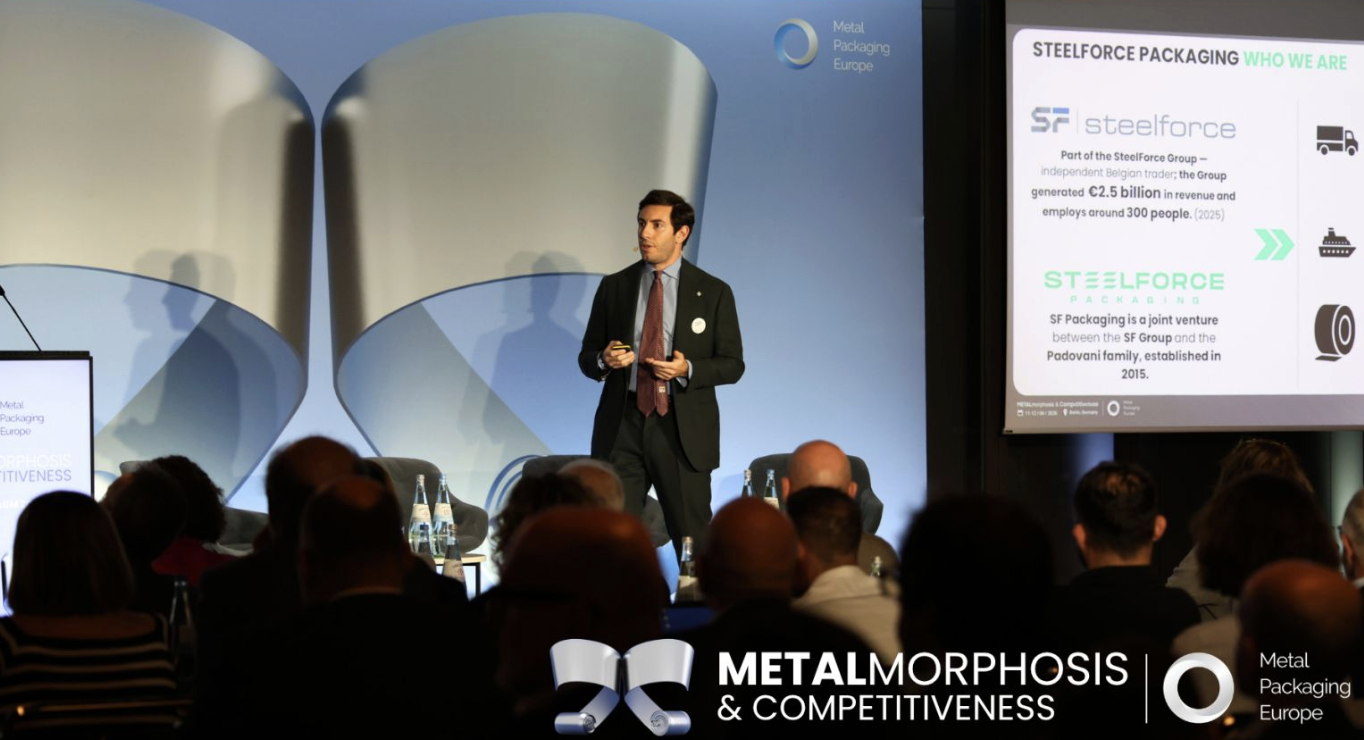
The global steel packaging industry is no stranger to change. Yet, according to Da vide Padovani, CEO of Steelforce Packaging, who presented a steel industry outlook, assessing market dynamics, trends and strategies at this year’s Metal Packaging Europe (MPE) conference in Berlin, the sector may be entering one of its most transformative periods in decades.
Caught between geopolitical tensions, regulatory intervention, shifting trade flows and growing sustainability demands, Europe’s steel packaging market is being forced to adapt faster than ever before. “This is a tough story,” Padovani told the MPE’s Metalmorphosis and Competitiveness conference. “We need to change, we need to adapt and understand future strategies with all of the uncertainties that are happening in today’s marketplace. But it’s also an exciting story because we have a lot of potential for growth in the industry and growth in the way metal is perceived by consumers.”
The production shifts towards Asia
At the centre of the discussion was a trend that has been reshaping global steel markets for more than two decades: the steady migration of steel production capacity towards Asia. Global production of tinplate in 2025 was 18.693 kilotons, with China accounting for the biggest share of this production with 7.396 kilotons, followed by Europe, which produced 3.653 kilotons, and Japan taking third place with 1.633 kilotons. Some experts in China suggest the country’s capacity could approach 11 kilotons in the next two to three years mainly due to two new integrated projects set to begin operations, one in Mongolia and another on the Chinese mainland.
The implications are significant. While Asian capacity continues to expand, production in Europe and the Americas has gradually contracted. Former manufacturing strongholds in Latin America have reduced output, while investment in new production facilities continues across China and India. “What we are seeing daily is an increase in Asian capacity through new manufacturing plants and projects, alongside a continuous reduction in American capacity,” Padovani said.
The result is a fundamental reshaping of global trade flows. As production capacity expands beyond domestic demand, exporters increasingly seek overseas markets, with Europe becoming one of the key destinations for imported steel packaging material.
Regulation becomes a market driver
European policymakers have not remained passive observers. Over the past eight years, a growing framework of trade and environmental measures has emerged to protect domestic industry while supporting the region’s climate ambitions. What began with safeguard measures and anti-dumping duties has evolved into a far more complex regulatory landscape that increasingly influences purchasing decisions, sourcing strategies and market competitiveness.
“Trade measures in the EU include safeguard measures, which expire on 30 June 2026, anti-dumping and the Carbon Border Adjustment Mechanism (CBAM). A new permanent safeguard regime will come into effect on 1 July, reducing the quota by 47%, but increasing the tariff price by 50%,” he said. According to him, the anti-dumping measures had been very effective, with duties ranging between 13.1% to 62.3% on various companies in China producing tinplate. Duties for tin-free steel (TFS) have been imposed on China and Brazil since 2022.
CBAM perhaps remains the most closely watched. Designed to account for the carbon footprint of imported steel, the mechanism aims to ensure European producers are not disadvantaged by stricter environmental requirements. The principle is relatively straightforward. “Whatever steel that comes into Europe that is made with less green technology is charged with carbon credits,” said Padovani.
Implementation, however, remains considerably more complex. Questions surrounding emissions verification, supplier certification, reporting requirements and enforcement mechanisms continue to create uncertainty across the supply chain. For many market participants, uncertainty around implementation has become almost as significant as the potential financial impact itself.
The import equation changes
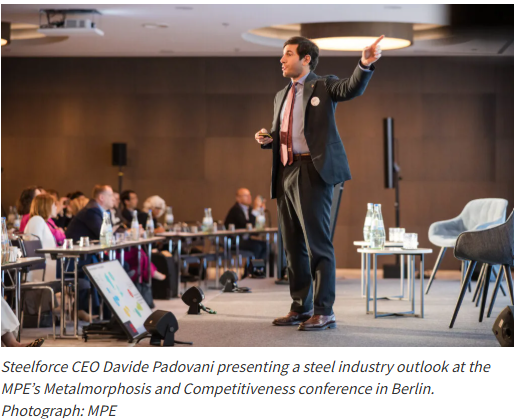
Trade restrictions are already beginning to influence purchasing behaviour. Europe’s safeguard system is expected to tighten further, with quota volumes reducing and penalties for exceeding allocations becoming more severe. While these measures are intended to support domestic producers, they also introduce additional complexity for buyers attempting to secure reliable supply. “I also see how difficult it is to project pricing and to get steel and to manufacture cans under the circumstances that we deal with,” Padovani notedSteelforce CEODavide Padovani presenting a steel industry outlook at the MPE’s Metalmorphosis and Competitiveness conference in Berlin. Photograph: MPE
Importers increasingly face a delicate balancing act: securing sufficient material while navigating a growing web of regulatory requirements and compliance obligations. Yet one observation presented during the conference stood out. Despite years of trade intervention, imports have not disappeared. Instead, many exporting countries have adjusted pricing strategies to absorb part of the regulatory burden and maintain competitiveness in the European market. “The regulatory impacts have done little so far because exporters to Europe have adjusted prices to absorb the current regulatory impacts.”
This ability to adapt helps explain why policymakers continue to refine and strengthen existing measures rather than relying solely on those already in place.
Costs move beyond steel
Trade policy is only one part of the story. Steel producers worldwide continue to face inflationary pressures driven by rising raw material costs, volatile energy markets, labour expenses and geopolitical disruptions.
Tin, a critical component of many steel packaging products, remains a particularly important cost variable. “When tin goes from $30,000 a tonne to $55,000 a tonne, the impact is significant.” Transportation costs also remain vulnerable to geopolitical instability and supply chain disruptions, adding another layer of uncertainty to an already complex global market. Taken together, these pressures suggest that European steel prices may face structural upward pressure in the years ahead, even as excess capacity in exporting regions creates downward pressure elsewhere. The result could be an increasingly fragmented global market, with regional pricing dynamics diverging more sharply than in the past.
Sustainability takes centre stage
If trade and regulation dominated much of the discussion, sustainability provided a more optimistic conclusion. For years, metal packaging advocates have argued that steel’s recyclability represents a significant environmental advantage. Increasingly, the data appears to support that position. The latest EU’s recycling rate for steel packaging stands at 84%, making steel one of the strongest examples of circularity within the packaging sector. “This is something we have to be proud of,” the conference heard.
The industry’s ambitions, however, extend beyond current performance. One of the most closely watched developments is the growing adoption of electric arc furnace (EAF) technology, which offers substantially lower emissions than traditional blast furnace production. Utilising the EAF technology, Steelforce’s En-finity steel – “the only can-to-can steel” – will be available next year, he said.
At the same time, producers are exploring ways to increase recycled content further and reduce the carbon intensity of steel production. The conclusion was clear: as recycling rates increase and recycled content rises, steel’s sustainability performance becomes increasingly competitive. “If we were to use 100% recycled material, steel could become the cleanest and most sustainable packaging solution per unit.” While that remains a long-term aspiration rather than a present-day reality, it highlights a strategic opportunity for the industry that extends beyond regulatory compliance alone.
More than a commodity
Perhaps the most significant message from Padovani’s presentation was that steel packaging is no longer competing solely on price. Market access, carbon performance, circularity and regulatory alignment are becoming increasingly important determinants of competitiveness. The industry’s future will not be shaped exclusively by steel producers, traders and canmakers. It will also be influenced by policymakers, environmental regulations and evolving consumer expectations.
That transition may create challenges. Yet it also presents an opportunity. For decades, steel packaging has largely been viewed as an industrial commodity. Today, it has the opportunity to reposition itself as a material that aligns closely with the circular economy principles increasingly demanded by governments, brands and consumers alike.
The irony is difficult to ignore. Many of the regulations creating uncertainty today may ultimately strengthen the industry’s long-term competitive position. As Europe tightens its regulatory framework and global trade flows continue to adjust, steel packaging finds itself at a crossroads. One path leads towards a future defined primarily by compliance costs and market barriers. The other leads towards innovation, circularity and renewed relevance.
The industry’s challenge is ensuring it follows the latter. Because in the race towards a lower-carbon future, the defining question may no longer be how much steel Europe can import. It may be how much sustainable steel the world will ultimately demand.
